
Wanless Park and Tennis Club History
Wanless Park has been in existence for over 80 years and the Tennis Club has been here in one form or another for over 60 years.
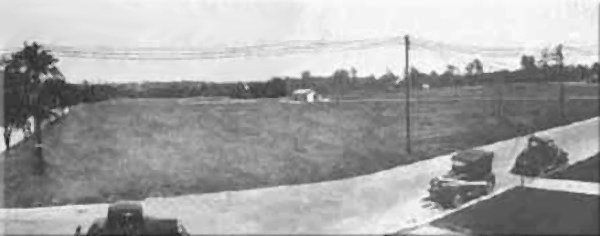
History of the Park
The land upon which Wanless Park sits was originally Waverley Farm. In 1912, Toronto Suburbs Ltd., guided by George Kappele and D.F. Crowagen registered a plan of subdivision for the old Waverley farm at Mount Pleasant Road and Lawrence Avenue. The developers named this new subdivision Waverley Park. The building of homes in Waverley Park was interrupted by the First World War and the Depression. On March 23, 1931 the City of Toronto expropriated land in the center of Waverley Park for the creation of a public park and issued an order to expropriate all lands: “lying north of Wanless Avenue and Wanless Crescent, west of Dundee Place (now Braeside Road), east of Kappelle Avenue (note the two l’s in Kappele) and south of Ranleigh Avenue” (which is now Haslemere Road). This plan passed through Council on June 15, 1931 and Wanless Park was born. It must be added that what is now just a gravel service road running into the Park was once a paved residential street then called Kirkcaldy Place, which ran from Wanless Avenue to Langton Avenue, because Langton continued south all the way to Wanless Crescent.
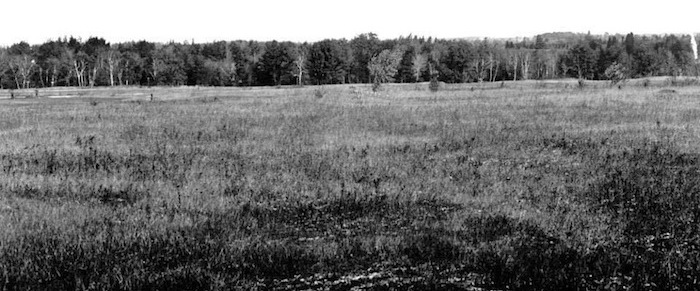
Parkland in 1912
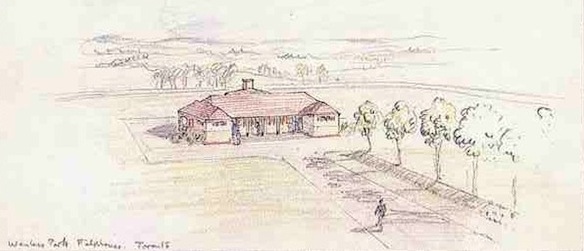
artist rendering 1934
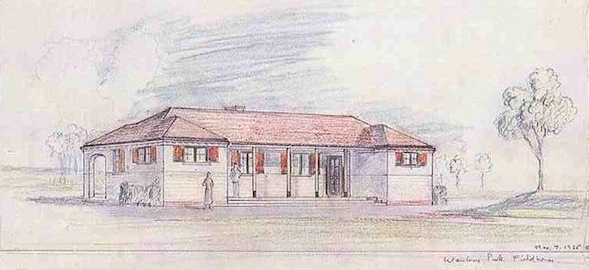
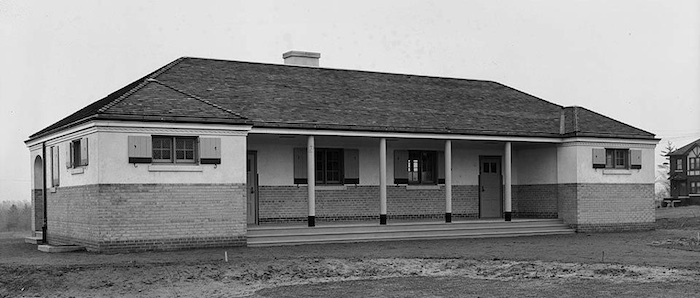
The clubhouse constructed in 1935
Even though all the streets were laid out, there were no homes built in 1931 in the park area, except for the odd homes on Lawrence Avenue East and Wanless Avenue further west of the park. At the time this expropriation cost the City the sum of $106,759.00 to obtain clear title to 7.876 acres of prime real estate. The value today would run into the tens of millions.
You may have noticed the number of street name changes in our immediate area. This occurred when the developers decided to rename streets after friends, places they knew, etc. The major developer in the area was W.S. Dinnick who in 1913 began a massive residential project called Lawrence Park Estates. This started at Blythwood Road (Victoria Avenue) and continued north towards Lawrence, which was named after the original owners of the farm at Yonge Street and Lawrence Avenue.
The immediate area surrounding the park was developed during the late 1930s. When Dinnick was laying out the Estates he changed Arundel Avenue and Crescent to Wanless Avenue and Crescent, naming them after his friend and prominent Toronto Businessman, John Wanless. Wanless was a very successful jeweler who branched into wholesale jewelry and became the largest business of its kind in Canada. He served as a Council member in the Township of York from 1903 – 05. Later he was an Alderman for Toronto from 1912 – 14. As a member of the Board of Eduction from 1921 – 22, he influenced various reforms in the school system with emphasis on having qualified teachers paid higher salaries. In 1937, John Wanless School was named after him, only four years before his death. In 1938, Dundee Place and Bowood Avenue became what is now Braeside Road and Ranleigh Avenue was changed to Haslemere later to be changed to Mildenhall Road.
Back to the park itself, the present clubhouse building was approved in March of 1935 and was completed later in the year. It has served as a home for many softball leagues throughout the years with some games drawing over 100 fans. In 1957 the playground was installed, followed in 1958 by the wading pool.
Tennis Club History
On July 13, 1950 Barber Construction Limited won the tender competition to construct the five courts in Wanless Park at a cost of $6,301.00. Although they were finished in September of 1950, an organized tennis club did not appear until the 1952 tennis season. The first president of the Club was the late “Mac” Bonnyman and he served in that capacity for three years, then as secretary for seven seasons. After Mac Bonnyman, G. Murray Williams took over as the next president. Williams also was the first Club Singles Champion in 1952. Other founders of the Club were Norm Paton, Frank Adams, Bob Middleton, Murray Brown and Peter Dimmer. Dimmer, who has trained many champions for over a quarter of a century had two young notables when our Club was young in Joan O’Brien, who gained the City Championship at the age of 16, and Tim Ralfe who went on to be a reporter for the CBC and CTV, and provoked Pierre Trudeau to utter his famous “just watch me” remark.
The year 1957 marked the first resurfacing of the tennis courts, but due to the declining interest in tennis coupled with the upsurge of golf, the Club disbanded in 1959, not to reappear until 1964.
In 1964, Stan Green and Dave O’Connor re-opened Wanless Park Tennis Club. The courts were a rough clay like substance during this time. But within four years there was a new surface as well as lighting on courts 4 and 5.
Under the leadership of Brian McDonough and head pro Nancy Green, Wanless was the host to the Ontario Juniors U18 championships until 1969. Doug Philpott and John Mitchell used to do the officiating. Huge wooden stands on the hill by court 5 held approximately 200 spectators.
The remaining courts were soon lit and tennis at Wanless became a night-time sport. The club was incorporated officially in the documents of incorporation dated 1970. Floodlights were installed in 1977 and an acrylic cushioned surface in 1980.
Back to the Future
In 2002 the courts were completely rebuilt and widened to provide more room between courts. 2002 also marked the year we moved into the 21st century with the debut of our website on the world wide web. Throughout the decade the website grew and provided more and more functionality to the club’s members. In 2010 Wanless introduced the ability to reserve tennis courts via the internet. This proved very popular and was followed in 2011 by full electronic membership and lesson registration accepting credit card processing and instant confirmations. This decade also saw tremendous growth in tennis, and programs such as house league and the Saturday Morning Fun program often host hundreds of participants at a time.
In 2014 Wanless Tennis was given stewardship over the complete field house by the city, and in return planned and funded an extensive renovation to provide a much improved and functional clubhouse for the members. At the Grand Opening in April 2014 Wanless celebrated its 50th year of continuous operation with a ribbon cutting ceremony opening the new clubhouse. Commemorative plaques from the city and a presentation by councillor Jaye Robinson contributed to the festivities.
Initiatives and leadership have consistently kept Wanless Park Tennis positioned at the leading edge of community tennis clubs in Toronto.
Based on a history of the club originally published in the 1980 Club Handbook by Toronto historian Al Navis, edited and updated for the club website with additional research by Jim Longo, and contributions from others. Photos and drawings from the City of Toronto archives.